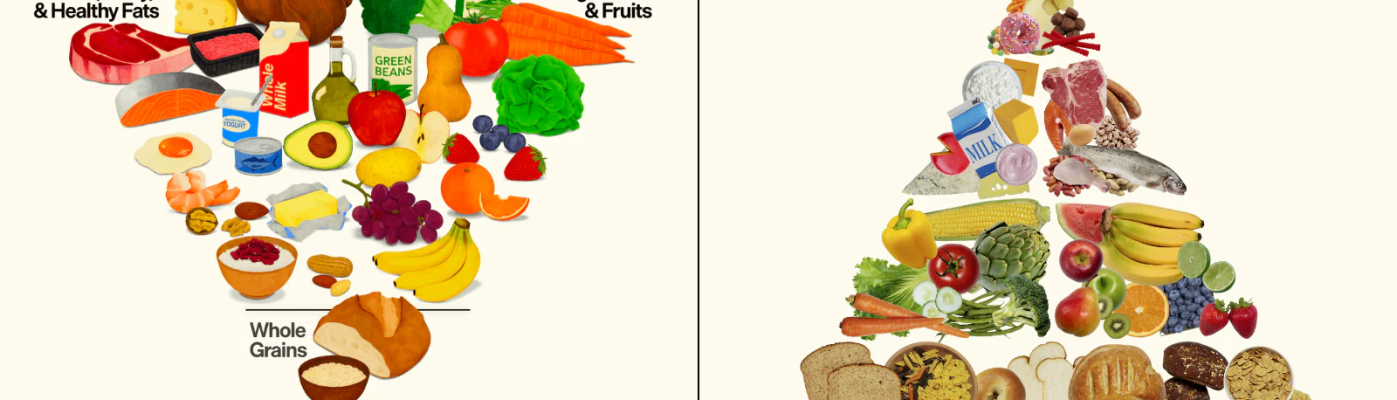
The Department of Health and Human Services, led by Robert F Kennedy Jr., has released new food guidelines, emphasising protein and saturated fat content. The guidelines override the original 2025 recommendations of the Biden Administration. New guidelines are traditionally released every five years. The newly unveiled food pyramid is the near opposite of the old version.
Experts agree that both of the pyramids have their advantages and disadvantages, with the previous’ emphasis on grain being called a result of grain companies’ influence, not health, and demonizing healthy fats, and the flipped pyramid encouraging too much saturated fat intake, and leaving out plant-based proteins while encouraging heavy meat consumption. It should be noted that there are recent allegations that the flipped food pyramids may have been funded by the dairy and meat industries, similarly to the original pyramid. The new guidelines also state an 100% increase in protein needed compared to previous guidelines, from 0.8 grams of protein per pound of body weight to 1.6 grams. This amount of protein is recommended, via scientific evidence, to build muscle, not for the maintenance of the average American, for whom the pyramid is meant. There is also limited evidence that this amount of protein can help a small amount with weight loss. Along with the increase in protein recommendation, the guidelines encourage getting a large amount of protein from meat, which experts state excess saturated fats in meat and dairy products may be dangerous for the heart.
The new guidelines have some other drastic changes: raising the recommended age for added sugar introduction from age 2 to age 10, which experts state is unfounded in science, as well as unrealistic: baked goods, treats, Halloween candies, even bread; evidence suggests against sugary drink consumption for those under 11, but not against added sugar altogether, as the newly released guidelines advise. Worryingly, the guidelines remove established clear limits on healthy alcohol consumption levels, as well as removing warnings of the cancer risks of drinking alcohol. The new food pyramid also does not allow unhealthy foods in moderation, which could be demonising for some people who partake in low, healthy levels of sweet or processed foods. There is evidence that cutting out all treats lowers willingness to continue diets and may convince people who are trying to be healthy that it is too difficult and they must stop the diet, or cause cravings that result in binge eating, reverting progress and making the person feel hopeless. Having a treat every once in a while may be more beneficial than cutting out treats altogether for those trying to eat healthier: moderation is healthier than restriction.
In all, experts are skeptical of any food pyramid– every person tailors their diet to their needs. Even if the guidelines are touted as making America healthy again, they diverge from science in a way that may be unhealthy. Though the basic recommendations influence how people eat, and any oversimplified food pyramid will have both its benefits and drawbacks, many are concerned about how different the guidelines are from past evidence, as well as from recent evidence. Will this affect people? Most likely not many people– not many people who are educated in the biases around them. But trusting government experts is difficult when they are becoming more and more presidentially backed and less and less evidence-based.
Jillian Parad, Staff Writer
Jillian Parad is a sophomore at Ledyard High School. She likes music, cats, and video games.
 COLONEL NEWS