Society as a whole has made great strides towards gender equality. More women on average get better grades and go to college compared to what it used to be. There’s been good progress, yet, one area that still lacks in this department is women in classical music.
Fiona Sinclair, chief executive of the Leeds International Piano Competition, has observed that female pianists are failing to reach the top of their careers despite there being an equal number of both men and women entering the Conservatory. Fewer than 23% of career pianists are women. In the last 40 piano competitions, only 18% were won by women. This problem persists at the top with festivals, recordings, and venues. Of the 20 piano soloists who performed in last year’s BBC Proms, only two were women, Isata Kanneh-Mason and Yuja Wang.
These demographics reflect what they say about women in the classical music sphere. They often say women aren’t as obsessed when it comes to music therefore they don’t practice as much. They also claim that women can’t play heavy pieces like Rachmaninoff because they lack the physical strength, as women. People also often comment on what they wear.
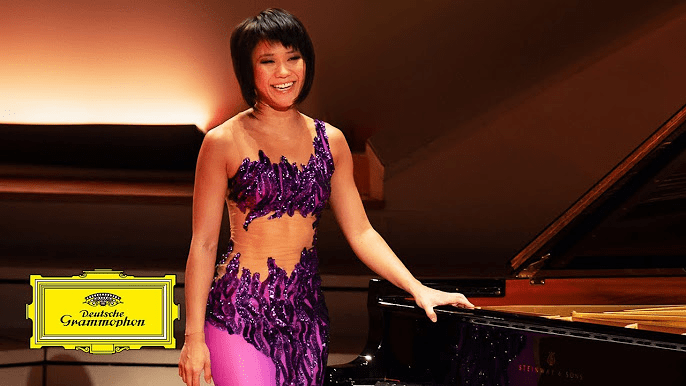
A popular victim of this is the great Yuja Wang.

(In this video one of the comments said her rise to fame was a result of her selling herself as a Playboy bunny)
Yuja Wang is a celebrated Chinese pianist born in Beijing. Her breakout role was when she replaced Marth Argerich as the piano soloist in the Boston Symphony Orchestra. Since the success of her career, there has been constant criticism about her concert apparel.
During the time when classical music was being codified, men were at the forefront of it. Of course, there were some women involved in the process, but obviously a very little amount. This resulted in the formal attire men wear for performing classical music. On the other hand, women don’t necessarily have an exact formal attire to wear for classical music. For example, when Eve Queler started conducting in the 1960s, critics said that so much as a zipper glistening on the back of her gown was considered distracting. This poses the question of what women should wear during performances, and what is deemed inappropriate. This brings us to Yuja Wang’s appearance at the Hollywood Bowl. A critic by the name of Mark Swed commented saying, “Her dress was short and tight… that had there been any less of it, the Bowl might have been forced to restrict admission to any music lover under 18 not accompanied by an adult.”Yes, the dress is short and tight, but if you were to look at women her age on the street, they would be wearing similar stuff.
Yuja Wang isn’t the only one limited to criticism. This type of criticism has existed for decades. Another famous example is the pianist Martha Agerich.
Still, even today, the issue persists. While the rest of the world has mostly moved away from its previous ideas of what women should wear, the classical music world hasn’t changed by much. There has been a good amount of progress made but, there is still more that can be done.
Calvin Miller, Staff Writer
Sophomore Calvin Miller is a staff writer for the 2023-2024 Colonel Newsmagazine. He likes classical music, playing the piano, and loves discussing pop culture issues.
 COLONEL NEWS